Running reminds me of truth

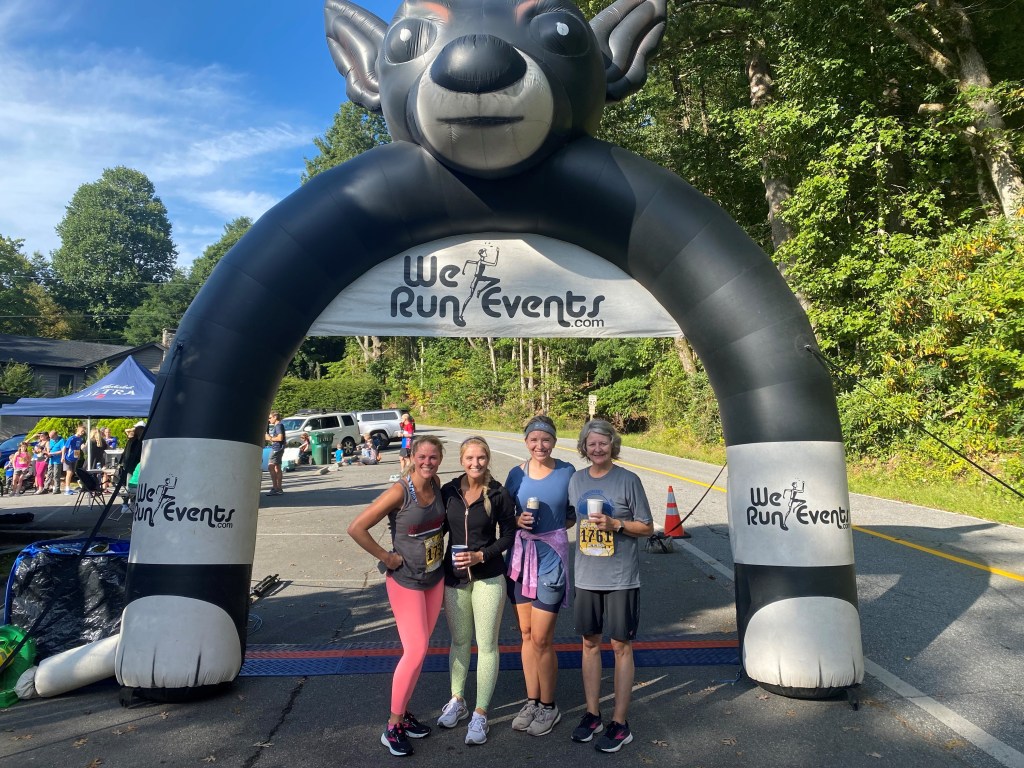
I don’t run. I don’t like it or enjoy it. It’s hard and it hurts. However, over the past two weekends I’ve found myself at the start lines (and finish lines) of two 5K races. Call it positive peer pressure or the blessing of friends who push me into hard, get-better places, regardless, the act of running challenges me, teaches me and most importantly, reminds me of truth.

I wish you could hear the intense debate going on between my ears – from the, “I can totally do this!” which is quickly objected by the “Why (in the world) did I agree to do this?” For me, the greatest battle isn’t as much physical as it is a mental and even a spiritual one.

My mind constantly wants to walk or even stop altogether. My mind tells me that I can’t. My mind tells me that it’s too hard or it’s too far. Isn’t this conflict between self vs. growth some of the most intense, yet worthwhile battles one can endure? Truth be told, my typical self wants to remain in a state of comfort, pleasure or even joy. I prefer the easy over hard, the light over heavy, warmth over cold, glee over sadness…I could go on and on. Don’t you?

Contrary to what some may think, (you know, the mythical viewpoint that if you follow Christ, life is easy street? Yea, that one) Jesus promises that we will experience suffering in this life. John 16:33A states, “I have told you these things, so that in me you may have peace. In this world you will have trouble.”

Jesus tells us that we will indeed have trouble. This comes at no surprise to anyone. Loss, pain & brokenness abound – the death of a loved ones & dear friends, the promise of new life only to end in a miscarriage, the battle of a terminal illness, the brokenness experienced by divorce, the confusion of job loss, promises unkept or the deep, dark and suffocating pit of depression.

It’s in these places, the suffering of this life, where God’s grace and almighty power are revealed. Continue reading John 16:33, Jesus says, “But take heart! I have overcome the world.” God, in His perfect and personal faithfulness, leaves us with this fact. This fully God and fully man experienced suffering in its full here on earth and overcame sin and death.

Suffering will indeed come, but God can give us grace and power to overcome every trial and to fulfill our purpose and mission in His Kingdom. “We are pressed down on every side by troubles, but we are not crushed. We are perplexed, but not driven to despair. We are hunted down, but never abandoned by God. We get knocked down but are not destroyed. Through suffering, our bodies continue to share in Jesus’ death so that the life of Jesus may also be seen in our bodies (2 Cor. 4:8-10).” This good news, my friends, from the One who always keeps His promises, gives me hope.

So once this perilous race called life is complete, will I be able to say, “I have fought the good fight, I have finished the race, and I have remained faithful. (2 Tim 4:7)?

Blessed are those who cling steadfast to Jesus’ promise and persist, even through life’s muck, to the ultimate finish line, where there is no suffering or pain. I need no peer pressure to sprint for that finish line!
Concrete Countertop DIY Project

Hey babe, think you and I can do a concrete countertop in the basement?” Without hesitation, I responded, “Well, yea!” Seconds later, after processing what I just agreed to, I asked, “Wait, did you say a concrete countertop? Do it ourselves? Do you know how to do this?” My hubs replied, “Well, I found a guy on Youtube that walks through the process and I think we can do it.

{Dramatic pause for some context} Those of you who know Corey, would know this idea wasn’t exactly out in left field. He is literally a jack of all trades who has never met a project he couldn’t conquer.

Okay, back to the story….If he says we can do it, well, let’s go! For some reason, I kept having mental pictures of us with giant sledgehammers when it was all said and done. What could go wrong?

Spoiler alert…..No sledgehammers were needed and although admittedly intimidating, the hubs and I turned out to be quite the team once got in a rhythm (He told me he liked the way I screeded! Oo la la! *wink*). The finished product isn’t perfect, but has “character.” However, I am extremely pleased. (So pleased, that I’d love to do a repeat in the boys’ bathroom)

I thought I’d share how we did it and our lessons learned in case you too have a wild hair.

Here is said “YouTube Guy.” (On a serious note: Watch this several times before you begin – he breaks it down into bite-sized steps that are easy to follow. Keep reading for the other video that was helpful as well)

Supplies We Used:

  • Hardi Board
  • Z Counterform Concrete Countertop Solutions Square Edge (Preforms)
  • Z Counterform Concrete Countertop Solutions FG50 Fiber Mesh
  • Z Counterform Concrete Countertop Solutions Z Clips
  • Z Counterform Concrete Countertop Solutions 5/8 Construction Screw
  • Z Counterform Concrete Countertop Solutions Z Liqui-Crete
  • Sakrete Sand Mix (7 bags)
  • Corded Drill
  • Mixing Paddle Drill Attachment
  • 5 gallon bucket
  • Magnesium Float
  • Steel Trowel
  • Concrete Skreed (we used a 1x4x4 board)

Step 1: Prep your surface

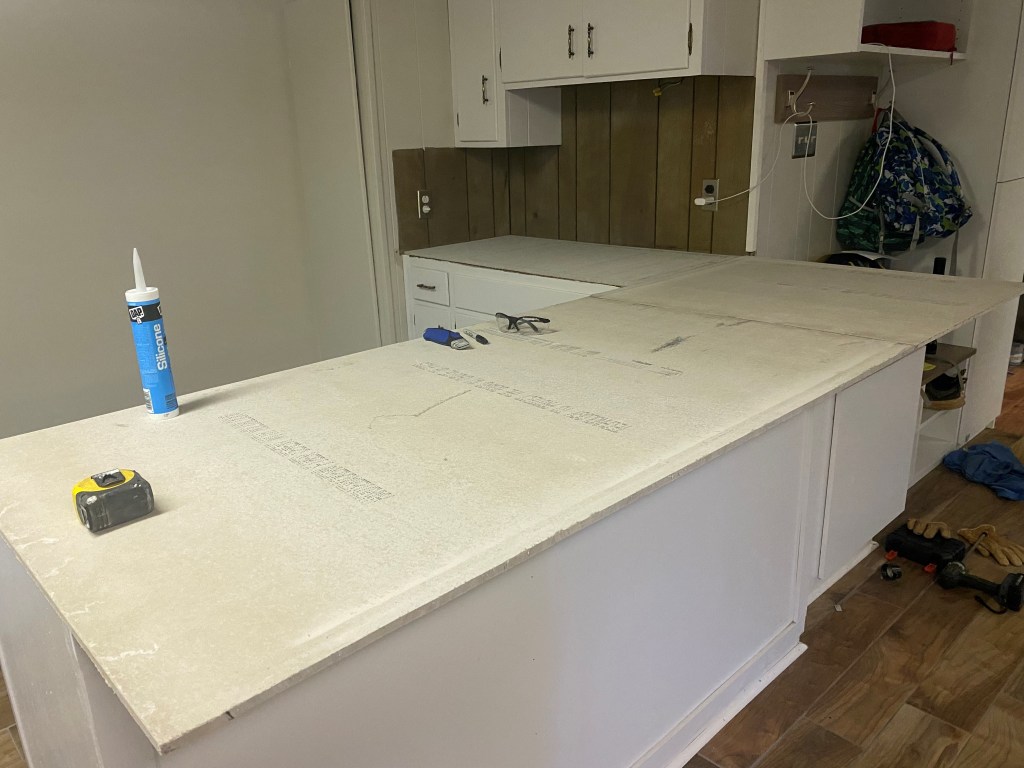
Corey demoed the old countertop. Then, he measured, cut and screwed down the Hardi board to create a ready surface for the new countertop.

Step 2: Secure your mold

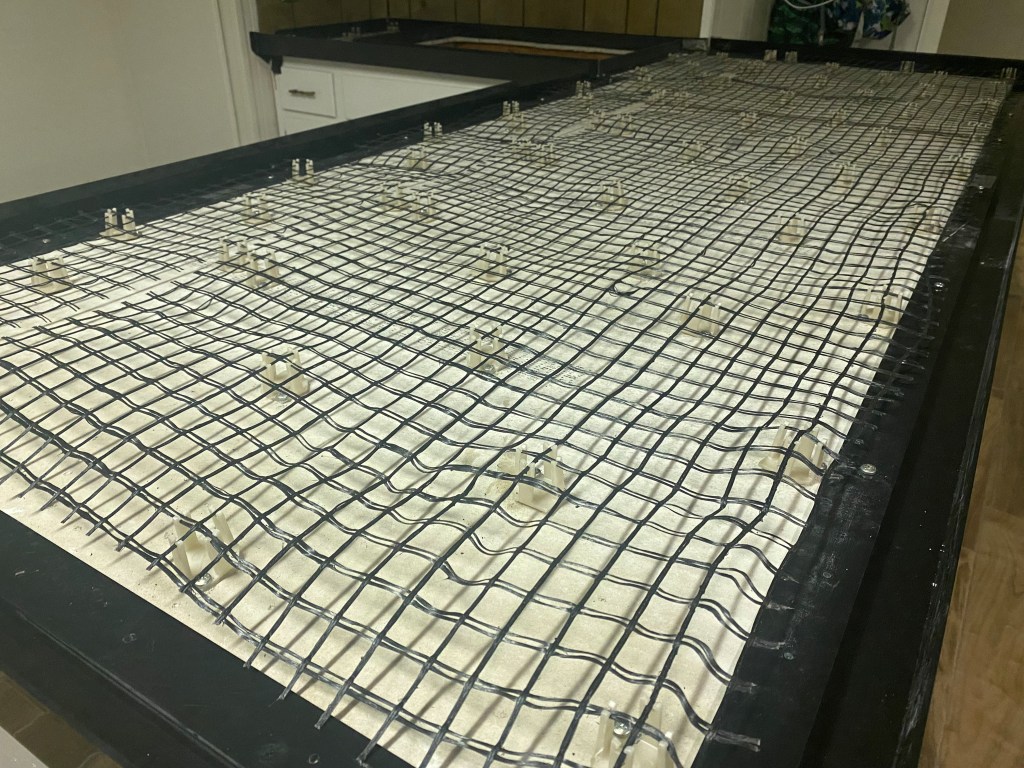
Corey measured and cut the Z Counterform Concrete Countertop Solutions Square Edge Preforms. This creates a mold for your concrete pour. Once your preforms are screwed in place, use duct tape to seal the corners.

Step 3: Install the reinforcement mesh

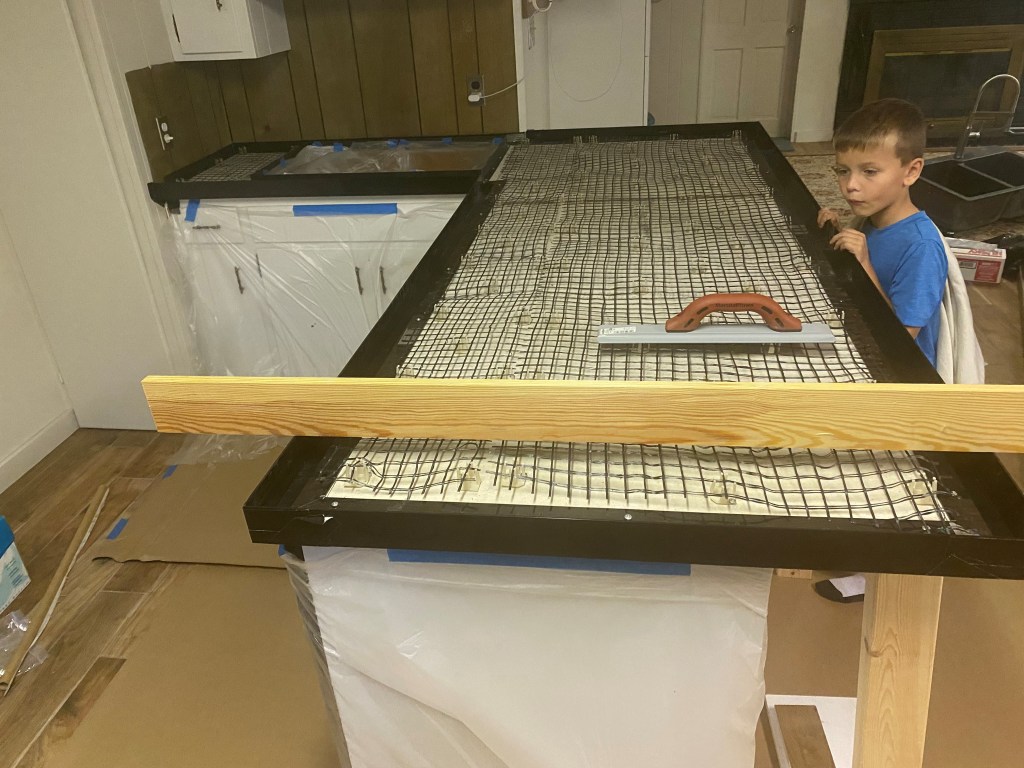
To ensure that your countertop surface is reinforced, this system recommends the Z Counterform Concrete Countertop Solutions FG50 Fiber Mesh. The Z Clips, which suspends the mesh so that it’s in the middle of the hardened concrete post-pour, are placed every 4 inches or so and are secured by the construction screws. Once this step is complete, you’re prepped and ready for concrete!

Step 4: Gather supplies & cover the floor and cabinets.

We taped down disposable butcher paper & sheet plastic to protect the surfaces around the countertops (Please note: you will spill!). This also created easier clean-up at the end. Gather all of your supplies before you start mixing concrete.

Step 5A: Mix, Pour, Screed & Repeat

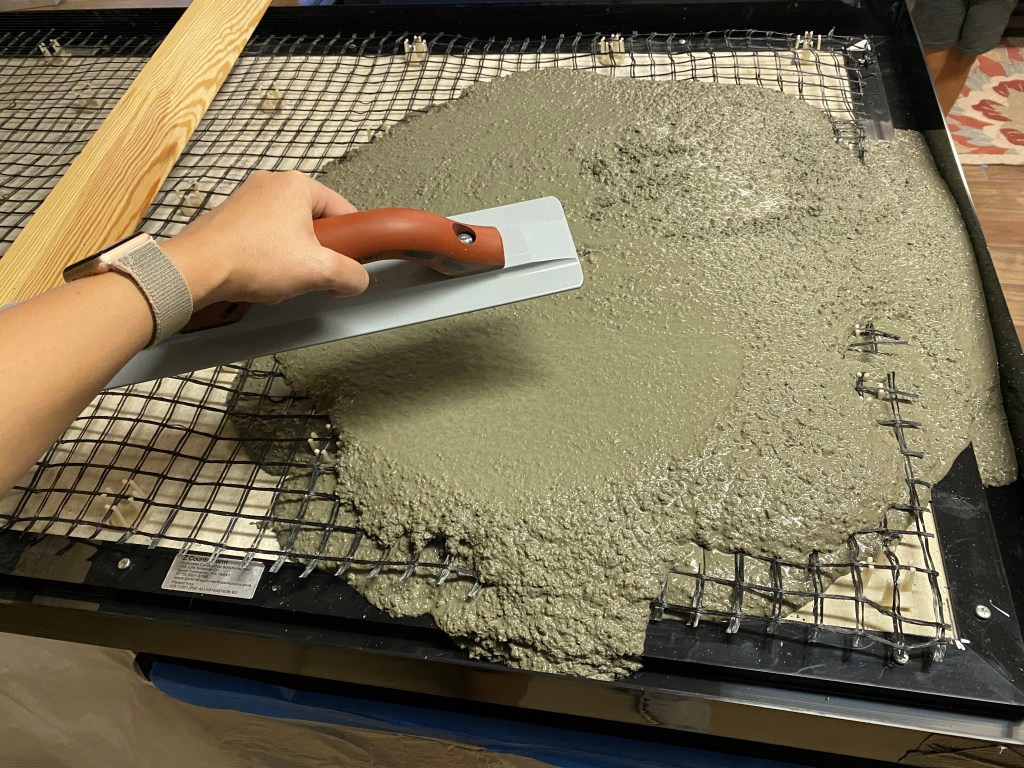
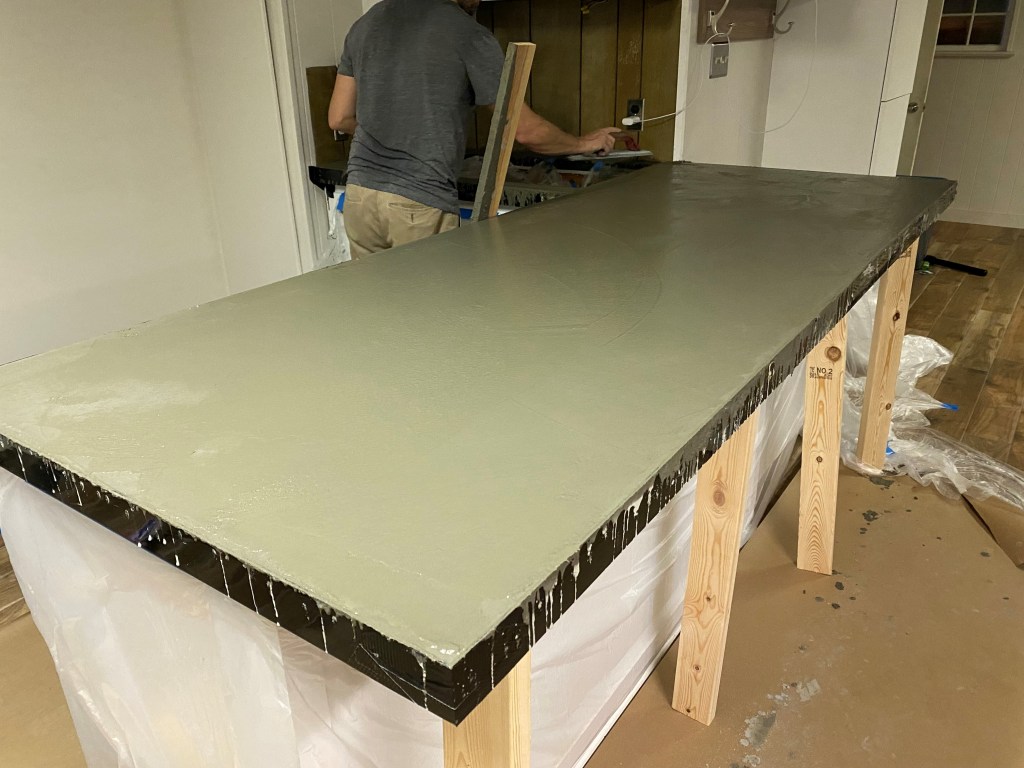
Once you start, you can’t stop until you’re finished. Make sure you have at least 5 hours (more if your surface is larger or if you’re super nervous or meticulous). The pour process seemed to work best with one person responsible for mixing (Corey), while the other is screeding & driving the magnesium float (Yours truly). You will mix 5 gallons of concrete at a time – 1 bag of concrete mix, plus 1 bag of Z Liqui-Crete (a fibrous material that strengthens the concrete) and water to make your mix the consistency of cake batter (5L worked like a champ for us).

Step 5B: Mix, Pour, Screed & Repeat

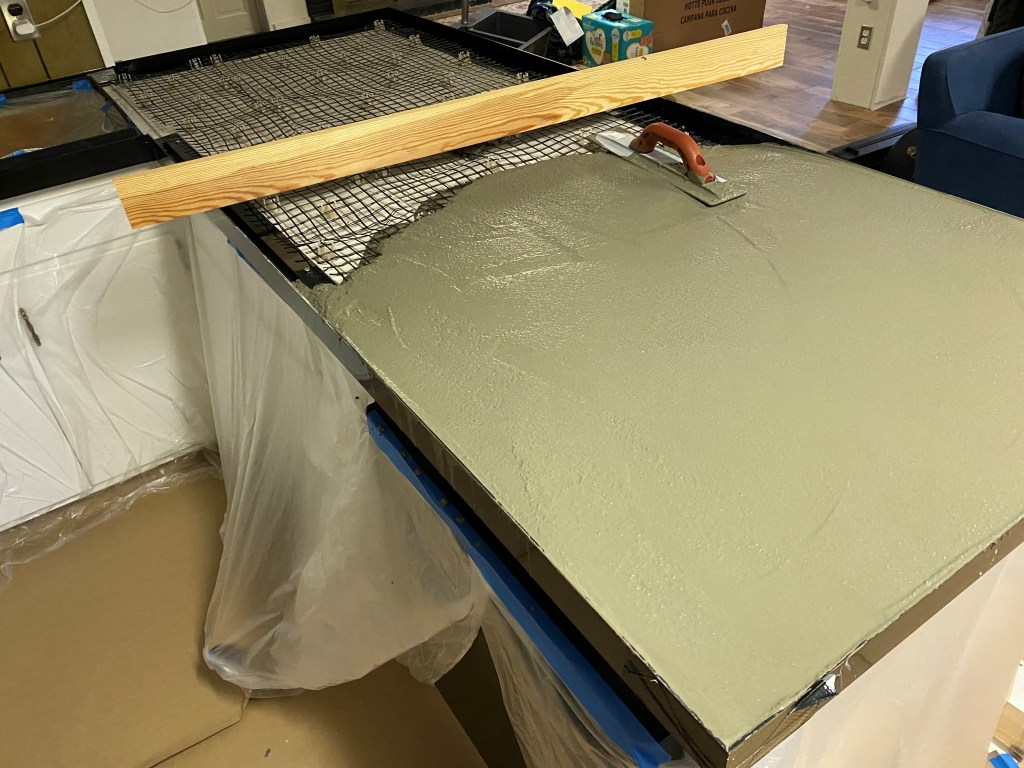
Fill the corners and edges first. Use the concrete screed to ensure your surface is level. This part is very forgiving so keep working with it until you have an even, fully filled mold. Use the handle of a screwdriver to tap the outside of the preform edges to allow airbubbles to rise to the surface (This is important: If you skip this step, your outside edges will have holes/pits!). Mix, pour, screed, float & repeat until your countertop mold is fully filled. Once your pour firms up a bit, use your Magnesium Float to smooth & even out the surface. This video was really helpful in getting the hang of the technique.

Step 6: Steel Trowel Finishing

This was the part we didn’t quite perfect – our timing was off with this step. The steel trowel is the final step before you allow it to rest and harden. Your pour needs to be set up enough, but not too much (right? Yea, exactly what we though too). I recommend watching this video for the best timing and technique for this step.

Step 7: Wait & Watch

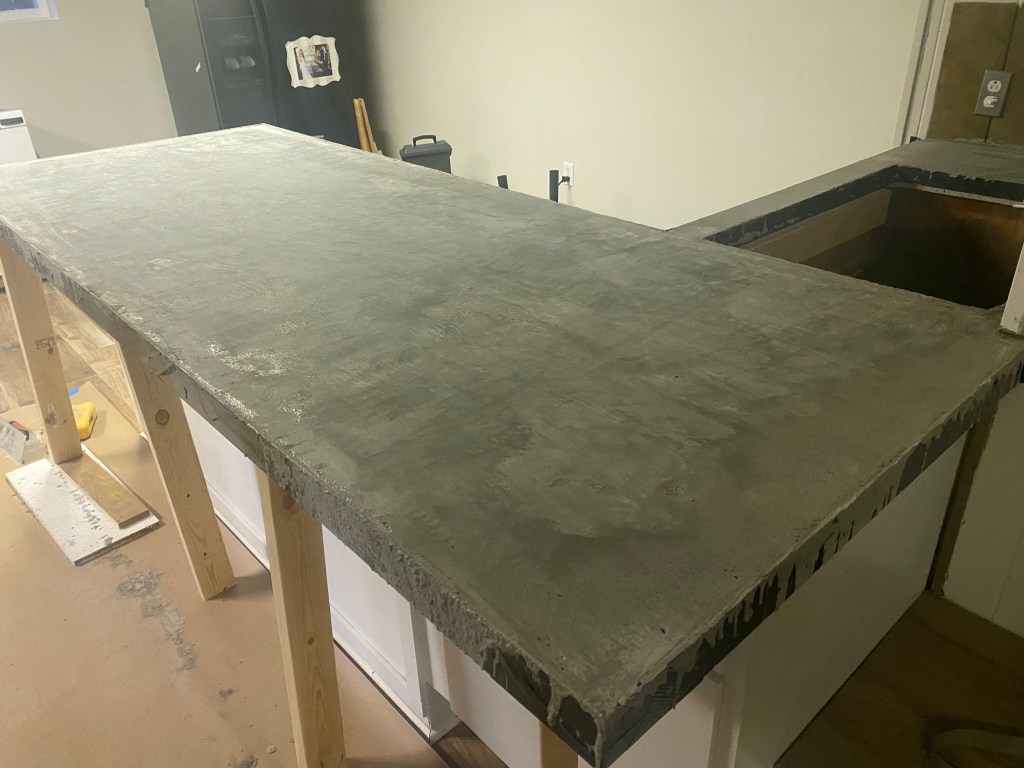
Once you’re finished, let it rest and watch it harden and lighten for 48 hours. This is when you’ll see the “character” present itself. We have some unique striations and some pitting we think occurred as a result of Step 6, but it looks great regardless. These imperfections will be sealed after it’s fully dry. If you happen to have imperfections that need to be repaired, this brand makes repair kits you can buy and apply.

Step 8: “Pop” the Preforms

Once your pour is fully dry, it’s time to remove your forms. This was the best part of this particular system – the preforms break off revealing your countertop edges. Tip: Make sure you sand the excess hardened concrete off the top of the edges before you break them off to ensure your edges don’t chip.

Step 9: Finished & Ready to Seal

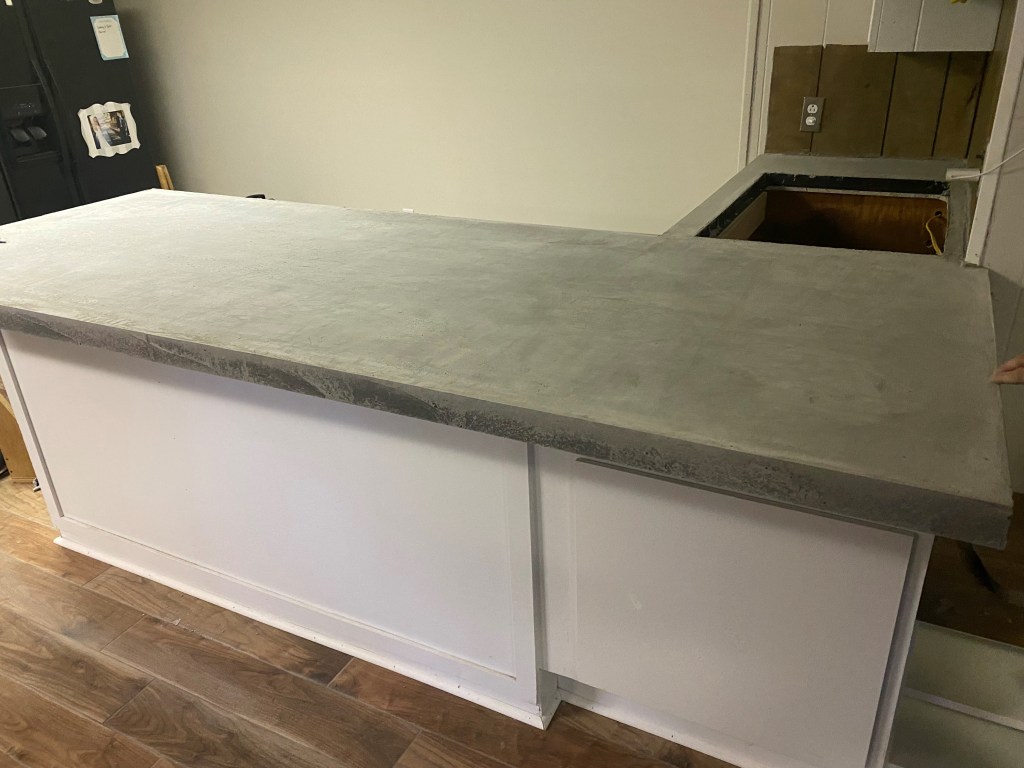
Concrete Countertop Solutions suggests waiting several more days to ensure your concrete is completely dry and then you can seal them using a special concrete sealant for this purpose. We also added the “shine” finish as a top coat which really set it off.

Isn’t she a beaut?! Now for a fresh coat of paint on the cabinets and backsplash and this kitchenette will be a true “glow up” story. Happy DIYing – tag me in your posts if you give it a try. IG: @LindsayKeisler

Watch the video I made documenting this project HERE.

Top 5 (plus 1 to grow on) Kid-Friendly Hikes within 1 hour of Catawba County, NC

River Bend Park

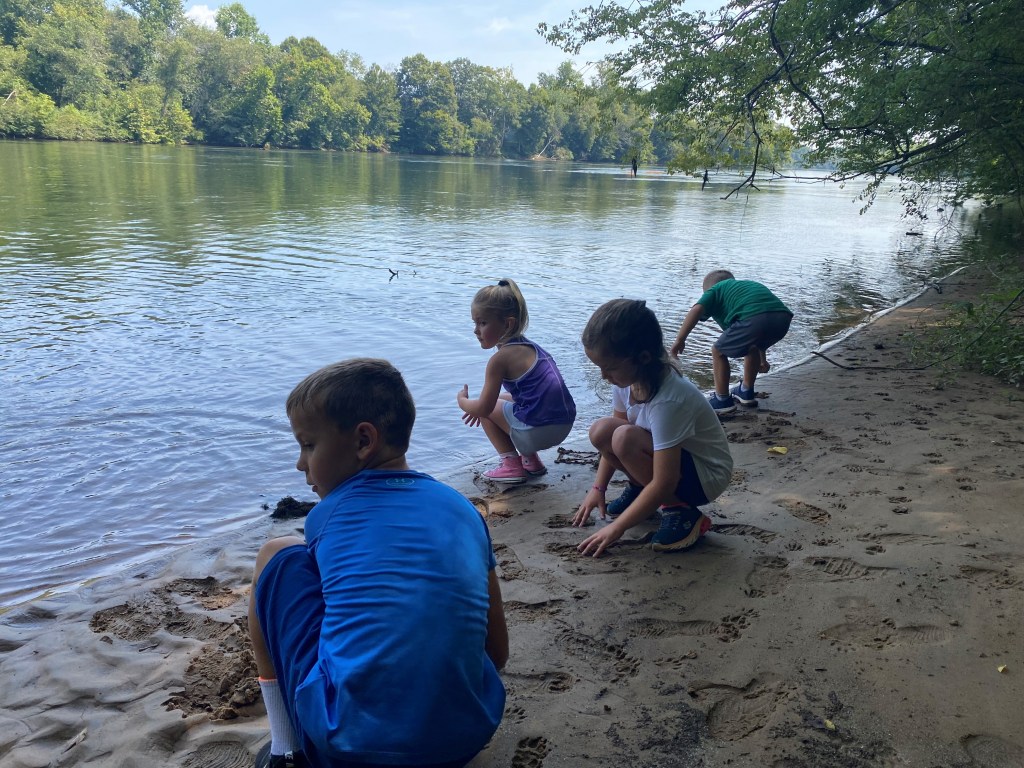
Located in Conover, NC, my beloved hometown, is River Bend Park, a local favorite for our crew, and in my opinion, the jewel in the crown of Catawba County’s Park System (although some may argue with me!). There’s stiff competition around here –did you know we rank 1st out of 100 North Carolina counties for number of square miles of green space per capita? Get outside and enjoy them! This park spans 690 acres, including just shy of 20 miles of hiking trails. Our crew loves the Red Line which runs parallel to the Catawba River shoreline for over a mile. Keep your eyes peeled for animal tracks – we spotted racoon, deer & heron during our last visit. We typically combine the Red Line with another overlapping trail to put in around 4 miles, which is just enough for the littlest in our pack. Stop by the Ranger Station when you arrive and grab a map or download it ahead of time to plan your route. Plan your visit to River Bend Park

Green Knob Trail

The Green Knob Trail starts from the Sims Pond Overlook (Blue Ridge Parkway Mile Marker 295), which is located in Julian Price Memorial Park only about 5 minutes outside of downtown Blowing Rock, NC. This is a moderate 2.3 mile loop perfect for the little hikers. It seemed as if there were adventures around every turn & twist which made our imaginations wander free – multiple creek crossings, rhododendron tunnels, a pass under the Blue Ridge Parkway, cattle gate pass throughs, a distant view of Grandfather’s sleepy profile and meadow meanderings, to name some of our favorites. Don’t travel so hastily that you miss the magical sights and the sounds all throughout this journey. The blankets of moss covering the forest floor, the trickle of clear mountain streams, giant trees towering overhead, twisted vines, purple mountain thistle and the butterflies frolicking across the meadow. Read more about the Green Knob Trail Loop.

Rocky Face Recreational Area

Located just 30 miles from downtown Hickory in Hiddenite, NC, this hidden gem (pun intended — Hiddenite, NC is famous for it’s gemstone mines) is one of the Greater Hickory Metro areas best kept secrets. Rock Climbers from miles around flock to this park to scale & rappel the rock face of the quarry area. We could have sat there for hours basking in the sun, while watching these hobbyist do their thing. This park in sum is 318 acres in size with 6 miles of hiking trails leading up to the mountain summit of 1,800 feet above sea level. We did about 4.2 miles with a stop at the top for a snack & some near 360 views of the beautiful NC foothills. Best part — we planned out our trip to enjoy a grand finale at the amazing playground with a zip line & huge slide! You can get to the playground from the parking lot, but then you’d miss the amazing views from the tail loops. Highly recommend for families or those itchin’ for some fresh air and adventure. Some day, I hope to return (without kiddos) and take on the Vertical Mile Challenge.

Boone Fork Trail

Do you like “rock music’? When hiking the Boone Fork Trail, there’s not a moment when you don’t hear the majestic ensemble of rushing water dancing over boulders, babbling streams, trickling creeks and drips through mountain nooks and crannies. I highly recommend this super scenic, moderately difficult 5-mile loop for your little hikers that are at least 6 years or older (unless you have a strong back). The trail departs from the Julian Price Park Picnic Area, which is located along the Blue Ridge Parkway (Milepost 296.5) only about 5 miles outside of Blowing Rock, NC. This trail takes you along and across cascading creeks, through open pastures sprinkled with wildflowers, between large rock boulders and underneath tunnels of rhododendron. Take a pit stop to cool off by the mist from several small waterfalls including Hebron Falls. Read more about the Boone Fork Trail here.

Baker’s Mountain Park

Baker’s Mountain Park is another local favorite. This park, spread across 189 acres of land with 6 miles of hiking trails, is located in the Mountain View area of Hickory, NC, less than 15 miles from the downtown district. Even on a cold and rainy day, this was a fun adventure! We scaled the red trail up to the highest point in the Catawba Valley at 1,780 feet in elevation and spotted some salamanders along the way. The topography is quite steep and can most certainly be a challenge for both big & little hikers alike so you may want to pace yourself and pack enough water. Unfortunately due to the weather conditions, we didn’t have much of a view at the observation platform. Take a pit stop in the gazebo at the summit for a snack before heading back down. Apart from hiking, Bakers Mountain Park features multiple picnic spots, has an all-abilities paved walking trail and is a hot spot for bird spotting enthusiasts. Plan your visit to Bakers Mountain Park.

South Mountain State Park

South Mountains State Park, located in Burke County just outside of Morganton, NC, is an adventurer’s playground, spanning nearly 21,000 acres with more than 40 miles of trails for hikers. We took the Hemlock Nature Trail through the Hidden Cove Trail to the High Shoals Falls Loop, which in sum was just over 5 miles ranging from easy to moderate and also strenuous. This was a true test of endurance for our littles (who am I kidding – it was for me too!) – we scrambled over boulders and scaled flights upon flights of steps. The promise of a 80-foot waterfall did the trick to help us persevere to the top….and boy was it worth it! The trail crosses the Jacob Fork River and reaches the High Shoals Waterfall. After you get your Instagram-worthy family pic, continue up the steep steps and cross the river again above the waterfall There’s a great spot at the top to celebrate your accomplishment and rest your tired legs before looping back down the mountain. Read more about South Mountain State Park.

Lead Like A Rookie

Listen in to my interview with Brandon Burton, Founder of ChamberChat Podcast, regarding my own leadership journey. The link to the episode is at the conclusion of this post:

“Lindsay Keisler brings her experience into our discussion this week to share how sometimes thinking like a rookie although on the surface seems like a big disadvantage can actually be leveraged into a great strength.”

“Lindsay is the President & CEO of The Chamber of Catawba County where she has served in various roles before taking on her current responsibilities.”

“As a young Chamber executive, Lindsay admits that she had insecurities and even some imposter syndrome when she first started until she learned to turn her open-minded rookie mentality into opportunity.”

“Lindsay shared some of the advantages of being a rookie that can even be adopted by more seasoned individuals in the Chamber industry if they are aware of this type of mindset.”

“A rookie is willing to take risks. A rookie needs to ask a lot of questions, rather than telling others “how it is”. A rookie brings a fresh set of eyes and is willing to make a change. A rookie also has to leverage the knowledge and skills of those around them.”

“When you {think like} you’re green, you’ll grow. When {you think like} you’re ripe, you’ll rot.” -Ray Kroc

,

Law of Reciprocity

Have you ever felt compelled to do something for someone who has helped you along the way – even if they’ve never asked anything of you in return? This innate urge is not just a guilty tug on the conscience, but social psychologists call this most powerful law of human nature the “Law of Reciprocity.” It’s so powerful that you may even repay an act of kindness even more generously than the original good deed that was extended to you. One may try to resist this law, but as a human, the urge to respond to a good deed is deeply-rooted and natural.  

Individuals who understand this law of human nature, and furthermore, embrace this philosophy, from my experience, are the most effective at fostering quality relationships, and growing their social capital and even their business. These individuals genuinely dedicate themselves to giving or adding value to others first, rather than placing priority on their own needs or goals. 

We all know them, and remember them. The person who picks up the tab of the patron behind them in the drive-through line. The person who proudly passes referrals or writes a glowing review for all their followers to see on social media. The “problem-solver” who suggests a solution that works. The contact who knows your goals and nudges you over the finish line of a major milestone achievement. The “mayor of their village”, not literally, but one who you turn to when you simply don’t know where to go or who to ask. The person who compliments you in front of your peers or superiors. The individual who “shows up” in the mountain top moments, as well as, the “valley” moments. 

Each month we host a connection event we call, “First Friday Morning Brew.” This event was founded several years back to challenge the traditional view of “networking” towards “net-giving.” Net-giving embraces the law of reciprocity. Instead of showing up to fill your own needs, we challenge each individual to show up asking the question, “What can I do for you?” We’ve witnessed the power of this concept in action month after month, and although, not all who attend “get it” – many have adopted this philosophy which they say has transformed the way they live and do business. By the way, as a result, it has reaped returns beyond their expectations. 

What can my team or I do for you? We would consider it a high honor to serve you – as a resource, connection point, an advocate or just a friend, partner and greatest supporter.  

Contact me: lkeisler@catawbachamber.org    

, ,

Leadership Advice Worth Following

What’s the best leadership advice you have ever received? Sometimes, it takes just a small sound bite to inspire, motivate, or keep you focused. I reflected this week on some of the advice I’ve been given along the way and thought I’d pass along the favor.  

 1)   Surround yourself with inspiring beings 

Those words are prominently displayed on a canvas in my office. No individual can become successful without the aid of others. Smart leaders surround themselves with even smarter people. Find mentors and team members that you wear like badges of honor. Don’t be intimidated by the talents and experience of others, leverage it to make yourself better. Hire or associate yourself with people who push you even more than you pull them. Look at it this way, if you are the smartest one around your table, your potential as an organization is capped.  

 2)   Do what you love. Love what you do. 

Why do you come to work every day? What is the “why” that drives you? A wise person once told me, “When you find your passion, you find your purpose.” Who doesn’t want to be fulfilled in, quite frankly, what they spend the majority of their time doing? Another wise individual once said, “Success is not the key to happiness. Happiness is the key to success. If you love what you are doing, you will be successful.” Don’t allow the relentless and debilitating statements in your mind talk you out of what your heart wants to explore.

3)      Learn something new every day.  

I’ve always been inquisitive. As a child, it was known as “nosey.” My parents stated that I would strike up a conversation with anyone from my friend’s grandmother to the grocery store clerk. They joked that by the time we were finished with my poking and prodding, I knew their life history and even the name of their hair stylist! Who am I kidding? I’m still like this! I believe that everyone has a story to tell and that I have something to learn. Whether it’s about a mistake they made, an industry in which they do business, a process they created, or a book they just read, there is always something I can take away. Next time you meet someone new, ask questions and listen.        

 4)      Think beyond your lifetime. 

What would your ninety-nine year old self tell you now? Would they be pleased with the life you’ve lived? I’m not referring to the money you have or haven’t made, the titles you have or haven’t held, or even the stuff you have or haven’t accumulated. What impact have you made on, and for, the next generation? It seems like our lives have become busier and busier. “If only there were more hours in the day.” We hear this constantly, don’t we? I believe the feeling of urgency is a heavenly reminder that our time is truly running out. What will be your legacy? It doesn’t matter if you are nine, or ninety-nine, each day is an important gift. How are you making the most of your time today? How are you thinking beyond your lifetime?

,

(Some) Lessons from 2020

One cannot thrive through times of VUCA (volatility, uncertainty, complexity, ambiguity) without consistent truth spoken into him/her.

Necessity, is indeed, the mother of invention. Overcoming toughness through creativity and grit is resiliency. Most have it, some won’t and don’t.

Don’t write “What does a 100% virtual Chamber look like?” on your vision board for the new year (2019 to 2020- yes, this is a true story!)….or do. We are much better for it, regardless of the toil.

Surround yourself with inspiring beings.

Leadership means making decisions and trudging ahead without knowing all the answers.

Life is so much sweeter when you are in the place to serve, rather than to be served. Coming alongside of those in crisis is a most honorable place to be.

Some pain and heartbreak is better to be experienced and endured between you, those who love you most and God.

You have the ability to be a source of stability, encouragement and hope.

All businesses are essential.

Your privilege and position is needed to create more and better opportunity for those around you. Don’t take this for granted. You don’t need to march or chant in the streets to impact change, however, marching and chanting will impact your heart deeply.

Where there is a will, there is a way. Relationships are intentional. Technology is an amazing substitute (thankful!), although, it will never replace face-to-face connections….or handshakes, or hugs.

Security and safety, although cherished, isn’t the most important.

Pandemics force people into nature – this is very good. Walks, hikes, pickle ball, kayaking, diy projects, neighbor check-ins…all very good.

The most simple moments of life are the most meaningful. Time is truly your greatest, most precious asset.

Dying-to-self is a daily struggle.

Moving your body will change your mind, heart and has the potential to nourish your soul.

Hindsight is 2019 (not 2020, like popular opinion *wink* ). Disruption is mostly good. The wise will embrace it and put one foot in front of the other.

We’ve all been in the same storm, but very different boats. Be empathetic and kind.

Hope is only found in the Lord, Abba Father; things eternal. Not in a leader, an elected official, nor another date on the calendar, good intention, a new goal or ritual.

Learning and growing with you. Happy New Year, friends.

,

Understand and respect those who have served the USA

I hope when you discover that a person you meet served in the military you always thank them for their service. But then what do you say? Like anything in which you associate yourself, it has a unique culture – ideals, standards, rituals, and even language – the military is no different. For those of us who have never served, we don’t need to know, nor do our veteran friends expect us to know, the details of expertise, rank and mission, but in order to better bridge the gap between yourself and veterans in your life, there are several things we can know and understand in order to show military cultural awareness and sincere empathy and gratitude.    

 PsychArmor Institute asked hundreds of veterans what they wanted civilians, employers, educators, health care providers, and therapists to know about them. To promote greater understanding of our veterans, I’d like to summarize their top fifteen responses with you. 

 1)      They are not all soldiers –  While many people, including the media, talk about military personnel as “soldiers” as a general term. This isn’t correct – “soldiers” are only in the Army. Although they all belong to the same team, military people are proud of their specific service branch. Knowing that the five branches of the armed forces are uniquely important, even if you don’t know the specifics, is key.

2)      Reserves are a part of the military –  Members of the reserves, who are seen in every branch, stay trained and ready to be called up when needed. They train one weekend per month and two weeks per year, but when not in uniform, they work in a civilian job in their own community.  

3)      Not everyone in the military is infantry – The range of careers in the military is vast and extremely diverse. Jobs range from mechanics, cooks, pilots and musicians to doctors, weapons specialists, military police, firefighters, air traffic controllers and thousands more job titles. Regardless of their MOS (Military Occupational Specialty), their skills, in combination with their leadership experience and self-discipline, make them highly sought-after employees in civilian workforce.

4)      They are always on duty – In the military, there are no days off. Even when on scheduled and approved leave, they have to be in the position to return to post, when called. 

5)      They have leaders at every level in the chain of command – Those who wear the uniform have a heightened sense of responsibility for others and accountability to others. Strong leadership is a foundation in their culture and is expected.  

6)      They take pride in their appearance, conduct and physical fitness – Even out of uniform they are held to a standard. Physical fitness matters in a real way. When they are called, they are responsible for fulfilling that mission. Moreover, all in military service are held to a standard called the Code of Military Justice. 

7)      Not all in the military have killed someone and those who have do not want to talk about it – even if you are curious – don’t ask, ever.

8)      They do not all have PTSD – There is a general misconception that all who deploy to combat develop PTSD. This is not true! Some develop symptoms, however while combat can be traumatic, it can also lead to great moments of reward and friendship.  

9)      Those who have invisible wounds are not dangerous or violent – Invisible wounds of combat are real injuries and cause real suffering. They deserve the same respect and treatment as physical injuries. 

10)   It is hard for those in the military to ask for help. – The military culture is rooted in service, sacrifice and helping of others, not for self. There’s an expectation of mission accomplishment, even at personal cost. Due to this long standing bias, reaching out for help is difficult for military people. Be patient and don’t give up!

11)   Military service changes a person permanently and it’s okay. – Like anything else, it’s a culture with its own standards, traditions, jargon, stigma, good and bad moments. This culture changes the lens in which they see the world, develop their character and equip them with an invaluable set of skills that will serve them both in and out of uniform.

12)   All veterans differ in how much they identify with the military after they leave active duty. – As in all cultures, some people are truly defined by their service and association with the military, while others consider it a part of their past and move on from it.  

13)   A military family serves along with the one that wears the uniform. Military families, spouses and children, have some of the most challenging circumstances in balancing relocations and deployments, and are the most resilient, strong, and confident as a result. Thank a military spouse for his or her service as well. 

14)   They are truly willing to die for each other and for their country. They would and they do. – Regardless of mission, political backdrop or who is leading our country at the time, they are willing to make the ultimate sacrifice for those serving to their left and to their right.  

15)   They chose to make this sacrifice for one reason, to serve something more important than themselves.  Those who signed on the line and wear the uniform live by a certain code: Honor, commitment and duty. They choose a life of service to protect and defend our flag, our freedom. 

Next time you meet a veteran or someone actively serving in the military, start a conversation. Say thank you. Inquire about which branch they served and what job(s) they held. Ask how their service shaped them or how it plays a factor in how they define themselves today.  

Learn more about HKY4Vets at http://www.hky4vets.com.

, ,

“You were made for such a time as this.”

“You were made for such a time as this.” is a statement that I play repeatedly in my mind as I push forward and lead my team, our organization and the business community in these unprecedented times. I find the most irony in the fact that the military term, “VUCA” (Volatility, Uncertainty, Complexity, and Ambiguity), was first coined during the year that this former “military brat” was born. This was either a warning to the world that a force to be reckoned with was rising through the ranks or a simple wink to me that “this too shall pass” and we’ll come out on the other side stronger, individually, as an organization and community.

The COVID-19 pandemic has caused significant disruption in our businesses, educational institutions, places of worship, healthcare community, non-profits and our overall economy. Business models that have carried industries to momentous peaks have been set ablaze by forced closures, supply chain disruption or decreasing sales. Education has been thrust into remote learning where instruction happens through a screen. Interactions and activities that were primarily “physical”, from doctors’ visits, shopping trips, client meetings, networking events and even birthday parties have shifted completely to online. There are few aspect of our lives that have been unscathed.

The COVID-19 pandemic has forced us into a state of hyper-change; however, pandemic or not, the world, even as we once knew it, has always been in a constant state of disruption, whether from shifting demographics, rapidly changing technology, to globalization and societal rift. As leaders, this leaves us two choices — assess, create opportunity and adapt, or become paralyzed, wither, and slip into obsolescence.

Ambiguity is often something that leaders try to remove or avoid. We want clarity, focus and strategy. We want more facts and less opinions or assumptions. Yet, isn’t it true that the potential for innovation and creativity is often missed in places of comfort, certainty, and status quo? While some organizations are constantly in a reactive mode, waiting to see how the world is changing, what the economic trends specifically dictate, and what customers say they want, others are creating and shaping opportunities. It’s in times such as these that we can leverage the volatile, uncertain, complex and ambiguous state we find ourselves in by adopting new ways of meeting the needs of our customers, enhancing our workplace culture, diversifying our offerings, simplifying and focusing our product lines, unlocking new revenue streams and learning through experimentation. Joe Britto, author and consultant once stated, “We’re no longer leaders being blown around like kites in a storm; we become kite flyers holding the wind in our hands.”

As a fellow kite-flyer, here are some of the steps I’ve journeyed through since March —

  1. Assess, evaluate and gather perspectives – Decide what is within your control and what is outside of your control. Arm yourself with solid analysis and information in order to make sound decisions about your business. Remember, you are not in this alone – many are invested in your business or organization, including your family, employees, partners and customers.
  2. Embrace your role as a powerful force for good during crisis — Reframe your mindset from change being something to resist to something to embrace. Instead of shutting down, make a commitment to lean in. Be transparent – involve your team in navigating the VUCA (Volatility, Uncertainty, Complexity, and Ambiguity). Leverage the strengths of those around you, in combination with your own to ask yourself — how can you thrive and make a difference amidst this disruption? Your team, customers & community? Don’t be the kite – fly it.
  3. Find the opportunity to be creative — experiment and fail forward — A great way to learn what will work or not work is by stepping into small “safe-to-fail” experiments and empowering your team to do the same. Instead of asking “why”, ask “why not?”

I hope you will share your own insight with me as we “hold the wind in our hands” together. Email me at lkeisler@catawbachamber.org – I look forward to learning from your wisdom.

Lifting the anchor is crucial

The words, equally beautiful and potent, found in the Declaration of Independence, came to represent a moral standard to which the United States should strive. “We hold these truths to be self-evident: that all men are created equal; that they are endowed by their Creator with certain unalienable rights; that among these are life, liberty, and the pursuit of happiness.”

However, the same words we hold true would not represent all lives, or should I say, all skin colors, as equal under the law until nearly two centuries later. Presently, all human beings in America are born free and equal; however, are all things equitable?

Equality is the state of being equal, especially in status, rights and opportunities. Having equity is different. It means just and fair inclusion into a society in which all can participate, prosper and reach their full potential.

Recent events have left me deeply convicted and disheartened. I have spent considerable time both in self-reflection, revelation and in contemplation regarding our organization and community, neighbors, co-workers, family members and friends. One resounding question continues to present itself — “Does a rising tide really float ALL boats?” Or do some boats have heavier anchors?

In taking a closer and deeper look at educational attainment, employment and business ownership, we have work to do, friends:

In Catawba County, the unemployment rate for African-Americans is nearly double the rate of white people. (American Community Survey)

White students in Catawba County are almost two times as likely to pursue education further than a high school diploma than their Black counterparts; and more than three times as likely as Hispanic students. (American Community Survey)

According to Kauffman, in 2018, white-owned firms had double ($2.38 million) the average sales of Asian ($1.19 million), Hispanic ($1.12 million), and Black-owned ($0.91 million) businesses.

Furthermore, Kauffman research shows that Black- and Hispanic-owned businesses have higher failure rates than do white- and Asian-owned firms.

These data points represent only part of the equation. If you are thoughtfully reflecting on this data like me (as opposed to interjecting “but ….” statements), other questions may come to mind. Questions like, “Why is this so?” or “How can this change?” or maybe even, “How can I do my part to impact positive change toward a more prosperous and more equitable Catawba County?” Here are only a few ideas to begin:

1. Listen, learn and reflect — If you look like me, you will never understand the experiences of racism or discrimination that our Black and brown friends have walked in their lifetime. I, and others like me, must choose to have the difficult conversation and ask the hard questions with a trusted friend or colleague. Ask, not to respond, but to learn and develop a deeper sense of empathy toward your neighbors, colleagues, fellow community members and friends.

2. Support minority-owned businesses in our community — Surely this goes without saying; however, increasing support for my Black and brown neighbors does not mean I intend to show less support to other businesses. I am not suggesting an either/or strategy, but giving more reasons to seek out, support and celebrate both. Here are only a couple reasons to add to those previously mentioned:

» Minority-owned businesses struggle with challenges that are common to all small-business owners — access to capital and contracts and finding reliable employees. More sales revenue, or having the opportunity to gain a new customer, has a direct impact on the success of their business.

» Data shows that Black businesses are more likely to hire Black employees, thus lowering the unemployment rate and helping more people of color achieve financial stability.

3. Identify and support ways to eliminate barriers to opportunity for people of color in our community — From educational attainment, skills development, diversity in the workplace, community leadership roles, access to entrepreneurship, housing, access to health care and more, how can we continue to look at each of these areas through a lens of equity?

So, knowing a little more than you did before reading this column, how would you objectively rank Catawba County now in terms of opportunities for all its citizens to prosper? My hope is that we can agree there is room, and motivation, to grow and change.

I look forward to continuing our work toward a more prosperous and equitable Catawba County and invite you to share your ideas, thoughts and perspective — email me at lkeisler@catawbachamber.org.

, ,